Resume Building Tips for Online Degree Graduates
Essential resume building tips specifically for graduates of online degree programs to highlight their unique skills.
Essential resume building tips specifically for graduates of online degree programs to highlight their unique skills.
Resume Building Tips for Online Degree Graduates
Hey there, future job-seeker! So, you've just wrapped up your online degree, and you're probably feeling a mix of excitement and a little bit of 'what now?' when it comes to landing that dream job. One of the biggest hurdles? Crafting a resume that truly showcases your unique journey and skills, especially when you've earned your degree online. Don't sweat it! This guide is packed with actionable advice, specific product recommendations, and real-world scenarios to help you build a resume that screams 'hire me!'
Let's be real, there's sometimes a lingering misconception about online degrees. Some employers might wonder about the 'real-world' experience or the rigor of an online program. Your job is to not just dispel those myths but to turn your online learning experience into a massive advantage. You've developed incredible self-discipline, time management, and digital literacy skills – all highly sought after in today's workforce. We're going to make sure your resume highlights every single one of them.
Highlighting Your Online Degree Effectively on Your Resume
First things first, how do you even list an online degree? It's simpler than you think, but there are a few nuances. You want to be clear and proud of your accomplishment, not try to hide it. Transparency builds trust.
Formatting Your Online Degree Education Section
When listing your degree, treat it just like any other degree. The key is to include the institution's name, the degree earned, and the dates of attendance/graduation. If the institution is well-known for its online programs, or if the program itself has a strong reputation, you don't necessarily need to explicitly state 'online.' However, if you feel it adds clarity or if the institution is primarily an online university, it's perfectly fine to include it.
Example 1 (Standard):
[Degree Name] | [Major/Concentration]
[University Name], [City, State]
Graduated: [Month, Year]
Example 2 (Explicit Online):
[Degree Name] | [Major/Concentration]
[University Name] (Online Program), [City, State]
Graduated: [Month, Year]
Example 3 (Online University):
[Degree Name] | [Major/Concentration]
[Online University Name], [City, State]
Graduated: [Month, Year]
Don't forget to include any honors, awards, or a high GPA if it's 3.5 or above. These demonstrate academic excellence regardless of the learning format.
Showcasing Transferable Skills Gained from Online Learning
This is where online degree graduates truly shine! Your online learning journey has equipped you with a unique set of highly valuable soft and hard skills. Don't just list them; provide concrete examples of how you've applied them.
Key Skills Developed Through Online Education
- Self-Discipline & Motivation: Managing your own schedule, meeting deadlines without constant supervision.
- Time Management & Organization: Juggling coursework, work, and personal life effectively.
- Digital Literacy & Tech Proficiency: Navigating various learning management systems (LMS), collaboration tools, and software.
- Problem-Solving & Critical Thinking: Independently researching, analyzing information, and finding solutions.
- Communication (Written & Virtual): Engaging in online discussions, crafting clear emails, participating in virtual group projects.
- Adaptability & Flexibility: Adjusting to new technologies and learning environments.
- Independent Learning & Research: Taking initiative to learn new concepts and conduct in-depth research.
How to integrate these into your resume:
1. Skills Section: Create a dedicated 'Skills' section. List relevant technical skills (e.g., specific software, programming languages) and then a subsection for 'Soft Skills' or 'Professional Skills' where you can include some of the above.
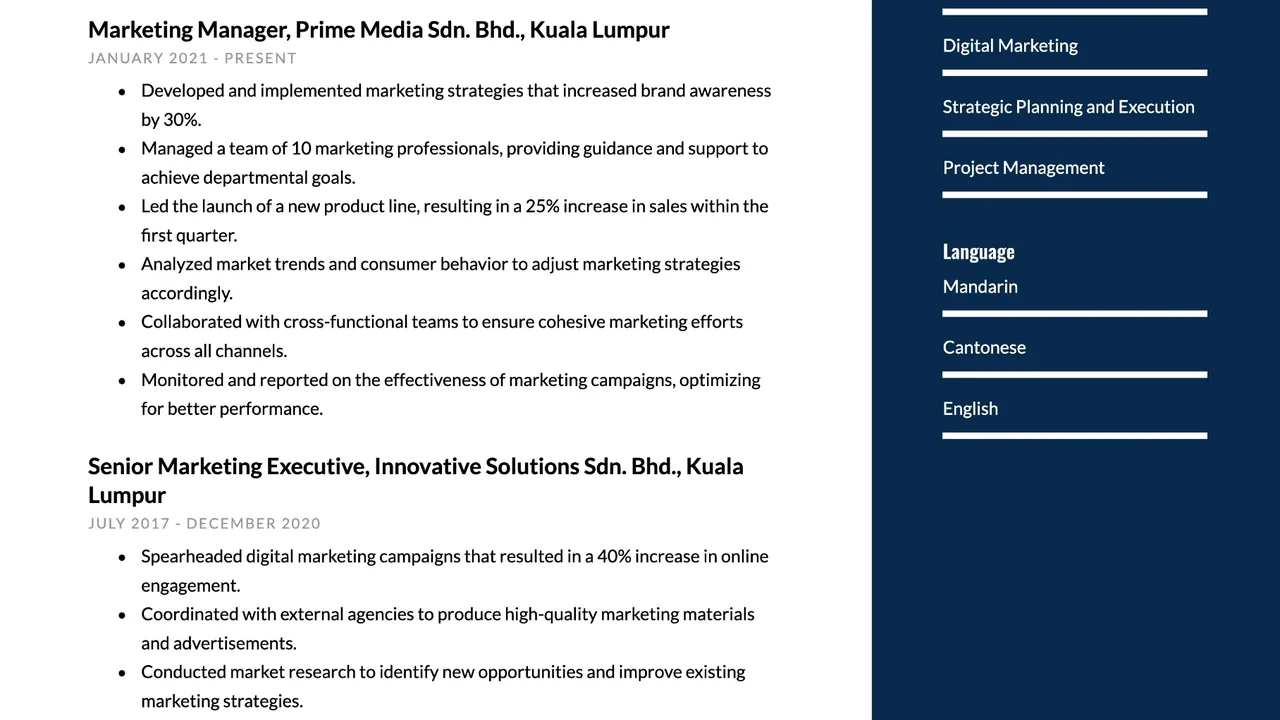
2. Experience Section: This is crucial. For each relevant work experience or project, weave in how you utilized these skills. Instead of just saying 'managed projects,' say 'Managed multiple concurrent projects, leveraging strong time management and digital collaboration tools to ensure timely completion of deliverables while pursuing an online degree.'
3. Summary/Objective Statement: Your resume's opening statement is prime real estate. Use it to immediately highlight your unique blend of academic achievement and self-driven skills. For example: 'Highly motivated and self-disciplined [Your Degree] graduate with proven ability to manage complex projects independently and collaborate effectively in virtual environments, seeking to leverage advanced [Your Field] knowledge and strong digital literacy in a challenging [Target Industry] role.'
Crafting Compelling Bullet Points for Your Experience and Projects
Generic bullet points are resume killers. For online degree graduates, it's even more important to quantify achievements and demonstrate impact. Think STAR method (Situation, Task, Action, Result) for every bullet point.
Quantifying Achievements and Demonstrating Impact
Instead of:
- Participated in online group projects.
- Used various online learning tools.
Try:
- Collaborated virtually with a diverse team of 5 students on a semester-long research project, utilizing [specific collaboration tool like Slack/Microsoft Teams] to deliver a comprehensive report that earned an A grade.
- Mastered 3 new software applications (e.g., Tableau, Python, Salesforce) through self-directed online modules, applying skills to analyze complex datasets and present findings.
- Managed a full-time course load of 15 credits while maintaining a 3.8 GPA, demonstrating exceptional time management and organizational skills.
If you completed significant projects as part of your online degree, treat them like work experience. Create a 'Projects' section and detail your role, responsibilities, and outcomes. This is especially valuable if you're light on traditional work experience.
Leveraging Online Portfolio Tools and Professional Networking Platforms
Your online presence is an extension of your resume. For online degree graduates, this is an absolute must. It's where you can visually demonstrate your skills and projects in a way a static resume can't.
Building an Online Portfolio and Professional Presence
1. LinkedIn: This is non-negotiable. Optimize your profile with keywords, connect with professors and classmates, and showcase your projects. Use the 'Featured' section to link to your portfolio or significant assignments. Make sure your 'Education' section mirrors your resume.
2. Online Portfolio Platforms:
- For Creative Fields (Design, Writing, Marketing):
- Behance (Free): Great for visual artists, designers, and photographers. Easy to upload projects and get exposure.
- Adobe Portfolio (Included with Creative Cloud): Seamless integration with Adobe apps, highly customizable, professional look. Price: Included with Adobe Creative Cloud subscription (starts around $20.99/month for single app, $54.99/month for all apps).
- Squarespace / Wix (Paid): Excellent for building a professional, custom website to showcase a broader range of work, including writing samples, marketing campaigns, or even code. Price: Squarespace starts around $16/month, Wix around $16/month.
- For Technical Fields (Coding, Data Science):
- GitHub (Free): Essential for developers to showcase code, projects, and contributions.
- Kaggle (Free): For data scientists, to share notebooks, participate in competitions, and demonstrate analytical skills.
- Personal Website/Blog (Paid/Free options): Use platforms like WordPress (free with self-hosting, or paid plans starting $4/month) or Medium (free) to write about your projects, share insights, and demonstrate thought leadership.
- For General/Academic Fields:
- Google Sites (Free): Simple drag-and-drop website builder for showcasing academic papers, presentations, or project summaries.
- Clippings.me (Free): Specifically for writers and journalists to compile articles and publications.
Usage Scenarios:
- Job Application: Include a direct link to your portfolio in your resume's contact information section and on your LinkedIn profile.
- Networking Events: Have your portfolio ready to show on your phone or tablet.
- Interviews: Refer to specific projects in your portfolio to illustrate your skills and experience.
Comparison & Pricing:
Free options like Behance, GitHub, and Google Sites are fantastic for getting started without financial commitment. They offer robust features for specific use cases. Paid platforms like Adobe Portfolio, Squarespace, and Wix provide more customization, professional domain names, and broader functionality, making them ideal for those who want a highly polished and personalized online presence. Consider your budget and the specific type of work you need to showcase when choosing.
Tailoring Your Resume for Each Job Application
This isn't just good advice; it's critical for online degree graduates. Generic resumes get lost in the shuffle. Every job description is a treasure map to what the employer truly wants.
Keywords and Applicant Tracking Systems ATS Optimization
Most large companies use Applicant Tracking Systems (ATS) to filter resumes. These systems scan for keywords from the job description. If your resume doesn't have enough matches, it might never reach a human eye.
How to optimize for ATS:
- Analyze the Job Description: Read it carefully. What are the key skills, responsibilities, and qualifications mentioned repeatedly?
- Mirror Language: Use the exact phrasing from the job description where appropriate. If they say 'project management software,' don't just say 'PM tools.'
- Keyword Placement: Naturally integrate keywords into your summary, skills section, and experience bullet points. Don't just stuff them in; make sure they make sense.
- Resume Format: Stick to clean, standard resume formats. Avoid fancy graphics or unusual fonts that ATS might struggle to read.
Tools to help with ATS optimization:
- Jobscan (Freemium): Upload your resume and a job description, and it will tell you how well they match, highlighting missing keywords. Price: Free for 5 scans/month, paid plans start around $49.95/month.
- Word Cloud Generators (Free): Copy and paste the job description into a tool like WordClouds.com or TagCrowd to visualize the most frequently used words. This helps identify key terms.
- Grammarly (Freemium): While not directly for ATS, it ensures your resume is error-free and professional, which is crucial once it passes ATS. Price: Free basic, Premium starts around $12/month.
Addressing Potential Employer Concerns About Online Degrees
While the perception of online degrees is rapidly improving, some employers might still have questions. Be prepared to proactively address them, not defensively, but confidently.
Proactive Strategies for Interviews and Cover Letters
In your Cover Letter: This is a great place to briefly touch upon the advantages of your online education. For example: 'My online degree from [University Name] honed my self-discipline and ability to manage complex projects independently, skills I believe are directly transferable and highly valuable for the [Job Title] role.' This frames it as a strength from the outset.
During Interviews: If asked about your online degree, focus on the skills you gained. 'My online program required a high degree of self-motivation and independent problem-solving, which I believe has prepared me exceptionally well for the demands of this role. I also became highly proficient in various digital collaboration tools, which I understand are integral to your team's workflow.' Turn any potential perceived weakness into a clear strength.
Emphasize Practical Experience: If your online program included internships, capstone projects, or practical simulations, highlight these heavily. These demonstrate real-world application of your knowledge, regardless of the learning format.
Networking and Informational Interviews for Online Graduates
Networking is always important, but for online graduates, it can be a powerful way to build connections and get your foot in the door, especially if you don't have a traditional campus alumni network to lean on.
Building Connections and Gaining Insights
1. LinkedIn: Again, LinkedIn is your best friend. Connect with alumni from your online program, even if you've never met them in person. Reach out to professionals in your target industry for informational interviews. Ask about their career path, their company, and advice for someone in your position.
2. Professional Organizations: Join relevant professional organizations in your field. Many have local chapters or online communities where you can connect with industry leaders and peers. This shows initiative and commitment to your profession.
3. Virtual Career Fairs: Many universities and industry associations host virtual career fairs. These are excellent opportunities to connect directly with recruiters and hiring managers from the comfort of your home.
4. Informational Interviews: These are low-pressure conversations where you learn about a role or industry. They're not about asking for a job directly, but about gathering information and building relationships. Often, these lead to job opportunities down the line. Prepare thoughtful questions and always follow up with a thank-you note.
Continuous Learning and Skill Development Post-Graduation
The world of work is constantly evolving, and your online degree has already prepared you for lifelong learning. Keep that momentum going!
Staying Relevant in a Dynamic Job Market
1. Online Courses and Certifications: Platforms like Coursera, edX, Udemy, and LinkedIn Learning offer countless courses and certifications to keep your skills sharp or learn new ones. Mention these on your resume under a 'Professional Development' or 'Certifications' section.
2. Industry Publications and Blogs: Stay updated on trends and best practices in your field by regularly reading industry-specific publications, blogs, and newsletters.
3. Workshops and Webinars: Many professional organizations and companies offer free or low-cost workshops and webinars. These are great for learning new skills and networking.
4. Personal Projects: Continue working on personal projects that allow you to apply and expand your skills. These can be excellent additions to your portfolio and resume, demonstrating your passion and initiative.
Remember, your online degree is a testament to your drive, adaptability, and ability to thrive in a self-directed environment. By following these tips and confidently showcasing your unique strengths, you'll be well on your way to landing that fantastic job. Go get 'em!
:max_bytes(150000):strip_icc()/277019-baked-pork-chops-with-cream-of-mushroom-soup-DDMFS-beauty-4x3-BG-7505-5762b731cf30447d9cbbbbbf387beafa.jpg)